
Ask someone to name a traditional Indian board game and you will hear Chaupar, Ludo or Snakes and Ladders. Ask for one from the south and the room usually goes quiet.
That is a shame. South India has some of the most interesting old games in the country. One is played by sowing seeds around a board with fourteen cups. Another sets three tigers against up to fifteen goats. A third is a race of pawns decided by cowrie shells. None of them needs a screen, a battery or a shop-bought box.
I design games from Goa, and old games like these are a big reason I think Indian themes belong on a table. This post covers three South Indian traditional games, what we actually know about them, and where the history turns fuzzy. I will point out the fuzzy parts as I go, because with games this old a confident date is usually a guess.
Why do South Indian traditional games get overlooked?
Most roundups lean on games with a famous story attached, like Chaupar, or on games that travelled widely. South Indian games lived mostly in homes, courtyards and temple floors, taught by watching rather than from rulebooks, so the rules change from family to family and the written record is thin.
A game taught on a kitchen floor leaves behind no publisher, no catalogue and no standard rulebook. Ask three relatives how Pallanguzhi is played and you may well get three answers, each delivered with total confidence.
That is also why I treat any single website’s version of the rules with some suspicion, this one included. What follows is the common core, drawn from Wikipedia and the regional names it records. (Your family’s version may differ, and that is the point.)
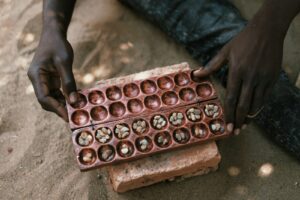
What is Pallanguzhi and how is it played?
Pallanguzhi is a traditional South Indian mancala game played on a board with two rows of seven cups, using seeds or shells as counters. Players pick up the seeds from a cup and drop them one by one around the board, capturing seeds when a sowing ends in the right spot.
The name changes with the language. It is Pallanguli in Tamil and Malayalam, Alaguli Mane in Kannada and Vamana Guntalu in Telugu. Move further out and you find Kasari in Odia and Satkoli in Marathi.
The board has fourteen cups in all. A full set uses 148 counters, and seeds, shells and small stones are all common. You pick up the seeds from one cup and drop them one at a time around the board, anticlockwise. If your last seed lands in a cup that has an empty cup beyond it, you capture whatever sits in the cup past the gap. Rules vary from house to house. In the version Wikipedia describes, unfilled cups are marked as rubbish holes and left out of the next round, and they rejoin the game if a player later has enough counters to fill them.
Pallanguzhi is a mancala game, part of a family of sowing games found across Africa and Asia. Wikipedia says ancient Tamils introduced it to Indonesia and the Philippines, where similar games are known as congkak and sungka. It is a good story and it may be true, but the page offers no dates, so I would hold it loosely.
What I can say with more confidence is why it lasted. Children learn to count with it, it builds hand-eye coordination, and all you need is a handful of seeds.
What is Aadu Puli Aatam?
Aadu Puli Aatam, meaning goat tiger game in Tamil, is a two-sided hunt game played with three tigers against up to fifteen goats. The tigers hunt the goats, and the goats try to block the tigers’ movements. The two sides play very differently, which is what makes it so good.
The names run across the languages of the region. Telugu speakers say Pulimekata or Pulijudamu. In Kannada it is Hulighatta or Aadu Huli. According to Wikipedia, the game is played across Karnataka, Tamil Nadu and the Telugu-speaking states, and it comes in three board layouts.
One board has become famous. It is drawn on the parapet inside the mahadwara of the Chamundeshwari temple on Chamundi Hill in Mysore. The game is also a close cousin of Nepal’s Bagh-Chal. The Wikipedia entry gives no age for it, so I will not put a century on it.
The part I love as a designer is the asymmetry. Most games give every player the same pieces and the same goal. Here one side is strong and few, the other weak and many, and each has to think in a completely different way. Modern designers spend years chasing that kind of tension. In Aadu Puli Aatam it sits on a grid anyone can scratch into a stone.
It also carries a lesson the source spells out: even the weak can beat the strong if they act together. You do not need to explain that to a child. The board does it for you. If you are teaching younger players, our guide on introducing kids to strategy games has a few ideas that apply here too.
What is Ashta Chamma and why does it have so many names?
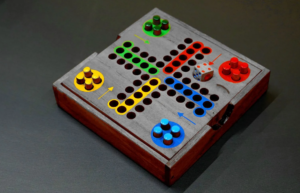
Ashta Chamma is a race game, normally for four players, played on a square board with cowrie shells instead of dice. It goes by many names across India, including Daayam in Tamil Nadu, Pakidakali in Kerala, Katte Mane or Chowka Bhara in Karnataka and Ashta Chamma in Andhra Pradesh and Telangana.
The board is normally a 5 by 5 square for four players, and each player has four pawns that start on marked squares of the outer ring. Movement comes from throwing cowrie shells, and a throw gives you 1, 2, 3, 4 or 8. A 4 or an 8 earns another turn. Pawns travel anticlockwise around the outer squares and clockwise through the inner ones. Land on an opponent’s pawn and you capture it, unless it is sitting on a safe square, which is marked with an X.
My favourite rule is that you cannot take a pawn into the inner squares until you have captured at least one opponent’s pawn. You have to be aggressive before you are allowed to win. A pawn must reach the centre square with an exact throw, and the first player to bring all four pawns home wins.
Wikipedia’s entry on Chowka Bhara describes it as one of the oldest board games in existence and links it to the Mahabharata. Wikipedia itself flags that link as needing a citation, so I would call it tradition, not fact. The game has stayed in popular memory all the same. It plays a pivotal role in the 2006 film Vanaja, and a 2008 Telugu comedy was named after it. We covered the Karnataka version, Chowka Baara, in our post on 3 traditional Indian board games.
South Indian traditional games at a glance
| Game | Also called | Players | Core idea |
|---|---|---|---|
| Pallanguzhi | Pallanguli, Alaguli Mane, Vamana Guntalu | Two | Sow seeds around fourteen cups and capture |
| Aadu Puli Aatam | Pulimekata, Pulijudamu, Hulighatta, Aadu Huli | Two sides | Three tigers hunt up to fifteen goats |
| Ashta Chamma | Chowka Bhara, Daayam, Pakidakali, Katte Mane | Usually four | Race four pawns round a 5 by 5 board using cowries |
Do modern Indian games borrow from these traditions?
Modern Indian designers mostly borrow South Indian stories, places and crafts, not the old rules. Two examples are Traders of Muziris, about an ancient Kerala port, and Athangudi: Artisans of Chettinad, about handmade tile floors. Both are modern designs, and neither is a version of the traditional games above.
Traders of Muziris, designed by Deepak Muraleedharan of Kerala, has players trading with foreign vessels at that ancient port. It is one of three games from the India Board Game Designers Collective. I am one of the collective’s project administrators for its current phase, so I am not a neutral voice here, but I think it is a fine example of how a South Indian story becomes a game.
Athangudi: Artisans of Chettinad, from the Chennai studio XOtoXO Games, came out in 2022. You play master artisans laying a floor in a Chettinad mansion with handmade tiles, for two to four players in 30 to 40 minutes. The real tiles are made by hand in Athangudi village near Karaikudi, coloured, packed with cement and left to dry for days.
Neither game rebuilds Pallanguzhi or Aadu Puli Aatam. The old rules stay in the old games. What the new ones borrow is the habit of building a game around a place and a craft.
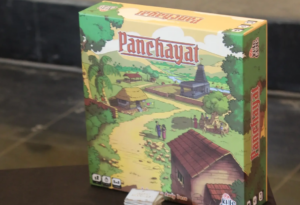
We do something similar at Kheo. Panchayat, which I designed, is a tile-placement game for one to four players about building a village from barren land, and a game takes around 30 minutes. It borrows an idea the old games also had: simple rules, everything visible on the table, and room for one clever move. For more on the wider scene, see our guide to Indian board games from Chaupar to today’s publishers.
Frequently Asked Questions
What is Pallanguzhi?
Pallanguzhi is a traditional South Indian mancala game. It is played on a board with two rows of seven cups, using seeds or shells as counters. Players sow the seeds around the board and capture seeds when a sowing ends next to an empty cup.
Is Pallanguzhi the same as mancala?
Pallanguzhi is one of the mancala games, a family of sowing and capture games found across Africa and Asia. The board, the rules and the name change from region to region, so it is a cousin of other mancala games, not a copy of them.
What is Aadu Puli Aatam called in Telugu and Kannada?
In Telugu it is Pulimekata or Pulijudamu. In Kannada it is Hulighatta or Aadu Huli. In Tamil, Aadu Puli Aatam means goat tiger game.
How many pieces are in Aadu Puli Aatam?
The game uses three tigers and up to fifteen goats. One player controls the tigers and the other controls the goats, or two teams can play.
What is Ashta Chamma called in Tamil?
The same family of game is called Daayam in Tamil Nadu. In Kerala it is Pakidakali, in Karnataka Katte Mane or Chowka Bhara, and in Andhra Pradesh and Telangana Ashta Chamma.
Which South Indian traditional game is easiest to learn first?
I would start with Aadu Puli Aatam. It has the fewest pieces, one clear goal for each side, and rules you can explain in a couple of minutes.
Are these games still played?
They survive mostly in homes and in memory, not in shops. That is exactly why they are worth writing down. The game also turns up on screen, in Vanaja (2006) and Ashta Chamma (2008).
One last thing
South India’s old games are not lost. They are unwritten, which is a different problem and an easier one to fix. Pick one this festive season. Draw the board, find some seeds and ask the oldest person at the table how they played it.
If your family’s rules differ from the ones above, I would like to hear them. And if you want to see how Indian stories look in a modern game, you can browse everything we make at Kheo Games.