
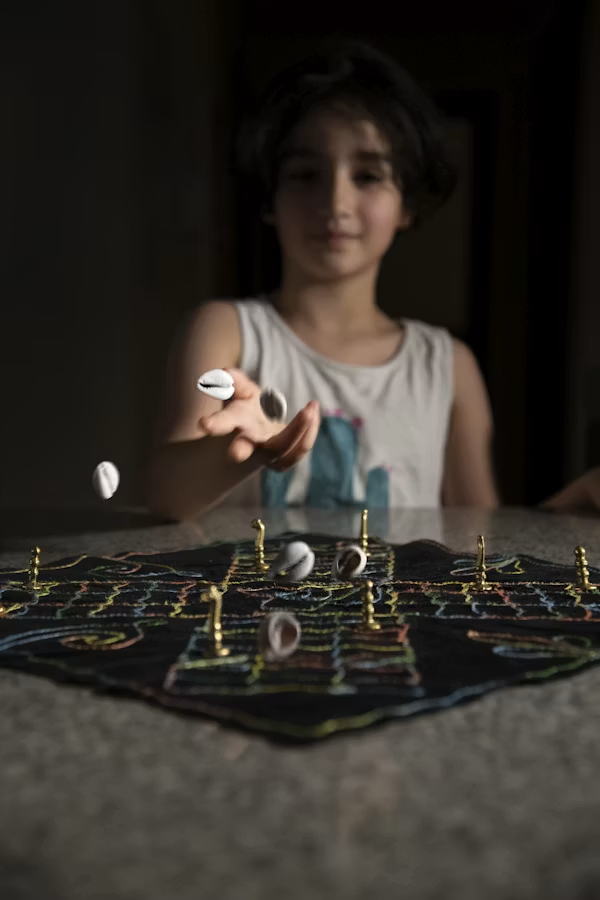
Indian Board Games: From Chaupar to Today’s Publishers
Ask someone to name an Indian board game and most people freeze after Chess and Ludo. India invented the game now sold globally as Snakes and Ladders, and it’s currently home to half a dozen studios shipping original tabletop games to a growing international audience. Indian board games didn’t stop existing after Chaupar boards stopped being embroidered on cloth. With this blog, I intend to focus on the studios building original Indian-themed games today.
What Actually Makes Indian Board Games Different
A handful of traits show up again and again across Indian games, old and new. These traits aren’t as central to the Western board game canon. Most traditional Indian games are built for a floor mat or a cloth spread between people, not a table. That keeps them physically communal in a way a boxed Eurogame usually isn’t, since anyone walking past can sit down mid-round without needing a chair.
Many were also designed to be cross-generational by default. A ten-year-old and a grandparent can play at the same table without either side needing a handicap, because the skill ceiling rests on social judgment and reading probability, not memorization. And a surprising number carry an explicit moral or philosophical layer baked into the mechanics, not bolted on as flavor text. Moksha Patam (which evolved into Snakes and Ladders) is the most famous example. Modern Indian studios have picked this habit back up rather than invented it from scratch.
The Modern Indian Board Game Renaissance
What’s happening now isn’t a revival of these old games. It’s a new generation of designers applying the same instincts, community play, cross-generational accessibility, real cultural specificity, to entirely original titles. We’ve written about why this renaissance is happening at all here. This section is about who’s actually building it, and Kheo Games is proud to be one of the studios doing that work.
Indian Studios Building the Board Game Industry
Kheo Games isn’t building this alone, and that’s worth saying plainly. A real category needs more than one publisher in it, and several other Indian studios are shipping genuinely well-regarded games right now.
Mozaic Games, based in Bangalore, has built one of the most varied catalogs in Indian tabletop. Indus 2500BCE is a flip-and-write civilization-builder set in the Harappan world. Players choose a city map, gather resources and artifacts, and race to build the most resilient settlement, while historically-accurate calamity cards periodically strike and damage what you’ve built.
A full solo mode is included. Karigar-e-Taj is a worker-placement game for 1-4 players, set in 1631. You play a Karigar, or artisan, competing with rivals to gather historically authentic building resources and construct the Taj Mahal level by level to win the Emperor’s favor. It successfully crowdfunded over $18,000 on Kickstarter and was featured on Rahdo’s list of top upcoming Kickstarter board games.
Chai Garam, designed by the same Sidhant Chand who designed Boitas, is a considerably lighter, faster game about running a chai stall in a bustling mela. You brew orders correctly, manage a customer queue where skipping the front of the line costs you points, and fend off rival vendors trying to poach your customers.
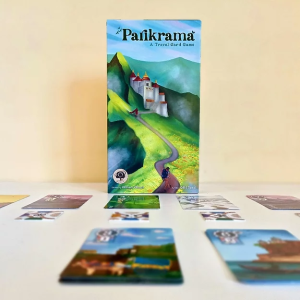
Zenwood Games, based in Mumbai, leans into a sharper economic and political edge. Tycoon: India 1981 is the studio’s flagship. It’s a heavyweight economic strategy game for 1-4 players, set during India’s industrial liberalization era. Players lead an industrial house, building factories, securing government licenses, and juggling Asset Value, political Influence, and long-term Favor across a shared map of India. It’s a serious piece of design work. It won the 2026 Goblin Magnifico award and the Dice Tower Seal of Excellence, and it currently sits at 7.8 out of 10 across more than 300 ratings on BoardGameGeek, making it one of the highest-rated modern strategy games to come out of India.
Zenwood’s debut title, Parikrama, is a lighter card game about traveling across India’s landscapes, a good entry point before jumping into Tycoon’s heavier systems.
GoIndia Games, also out of Bangalore, has built its identity around historically-grounded epics and genuinely sustainable manufacturing. Bharata 600 BC is, by some measures, the best-selling Indian-designed modern board game to date. It sets 2-8 players in the era of the sixteen Mahajanapadas, the great kingdoms of the ancient Indian subcontinent. Each player leads a Mahajanapada ruler, managing armies, resources, and territory expansion while defending against rivals and natural disasters. The physical production is a big part of its reputation: over 550 components, including 64 handmade artisanal wooden pieces crafted using the traditional Channapatna technique and dyed with natural, non-toxic colors, all manufactured entirely in India.
Their most recent creation, Nayakas, designed by Andy Desa, is also an amazing worker-placement game set after the fall of the Vijayanagara Empire. The gameplay is truly appreciated by many gamers who love the asymmetric nature of the four factions in the game.
Luma World takes a different angle entirely, closer to educational design than pure strategy. Lakshadweep is a two-player tile-placement game where you build out an island archipelago. You add houses, fisheries, hotels, ports, forests, and coral reefs, balancing development against ecological preservation. It’s explicitly aligned with several UN Sustainable Development Goals around sustainable tourism and ocean conservation. It’s also the only Indian board game to date to receive the Dice Tower Seal of Approval, a genuinely respected mark of quality in the international hobby space. Its two-player-only format makes it one of the better entry points on this list if you’re shopping for a couples’ game night rather than a full table.
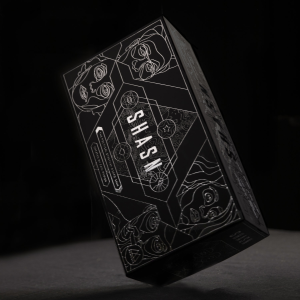 Shasn, published by Mumbai-based Memesys Culture Lab and designed by Zain Memon, takes the most unlikely theme on this whole list: Indian electoral politics. It’s a strategy game for 3-5 players, with a 2-player mode sold separately. Each player takes on the role of a politician contesting a nine-constituency election. You take a public stand on real ethical and political dilemmas, trade favors with rivals, and try to win over the most voters before the game ends. Shasn grew directly out of a documentary Memesys made on the rise of Delhi politician Arvind Kejriwal, and the game leans hard into that same close-to-real-life energy.
It raised over $339,000 from more than 4,200 backers on Kickstarter in 2019, and it went on to win the Social Impact Award at IndieCade Europe that same year, a respected honor in the indie game world. You can see its full rules and community ratings on BoardGameGeek. It’s one of the sharpest, most adult entries in Indian tabletop right now.
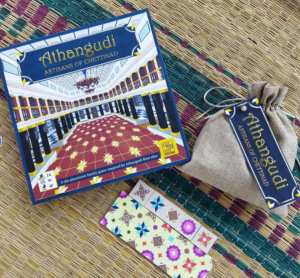 XOtoXO Games, based in Chennai, takes yet another angle: everyday Indian heritage and craft rather than history or politics. Their debut title, Athangudi: Artisans of Chettinad, is a light-strategy tile-laying game for 2-4 players, built around the real, hand-poured cement tiles of Athangudi, a small village in Tamil Nadu’s Chettinad region. In the game, you play a master artisan laying the floor of a grand Chettinad mansion, competing to build the most striking pattern while chasing scoring goals along the way. The real tiles the game is based on take skilled artisans nearly two weeks to make by hand, and the game reproduces that same careful, colorful geometry on the table.
Kheo Games: Building Modern Games From Indian Soil
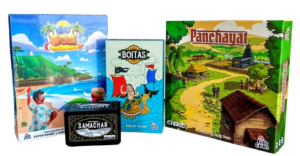
Panchayat: the flagship
Panchayat is the pinacle of Kheo Games, and it’s still the clearest expression of the studio’s whole philosophy. The name comes directly from Indian village governance. In traditional Indian villages, a group of five respected elders called the Panch, Sanskrit for “five,” governed local affairs. Panchayat literally means “the rule of the five.” In the game, you take on the role of one of those governing bodies. You turn a barren piece of land into a thriving village, one tile at a time, competing against up to three other players or playing entirely solo.
It’s a light-strategy tile-placement game for 1-4 players, roughly 30 minutes a session. It was designed by Andy Desa, with artwork by Vesley Carrasco. The box carries real strategic texture for its weight class: 72 building tiles, 20 adjacency bonus tiles that reward how you cluster your village, 18 end-game bonus tiles, 12 placement bonus tiles, and 5 dedicated solo objective tiles for anyone playing alone. There’s even a “Zamindar discard” mechanic, named for the landowning officials of Mughal and colonial-era India, that governs how unwanted tiles get cycled out of the game. It’s been reviewed favorably by outlets like Planet Dave, and it remains the game most people mean when they say they’ve played something from Kheo Games.
Boitas: the newest release
Boitas is Kheo Games’s newest title, and its most historically specific one yet. The game is named for the traditional wooden sailing boats used by the Sadhaba, or Sadhava, merchant seafarers of ancient Odisha. These traders braved unpredictable seas to build maritime trade routes connecting Odisha’s coast to Southeast Asia, Africa, and the Middle East, carrying spices, textiles, and precious metals in vessels crafted with real nautical skill.
In the game, designed by Sidhant Chand with art by Janki Bavle, you step into the role of one of those Sadhaba traders. You use your boitas to sail to distant ports, trade for luxury goods, and build prosperity for yourself and your home kingdom. It’s a trick-taking card game for 2-4 players, roughly 30 minutes long, similar in spirit to the trick-taking games already common at Indian family gatherings, but built entirely around this one specific, under-told piece of coastal Indian history. It’s a small game with a genuinely rare theme. Not many tabletop titles anywhere put Kalinga-era maritime trade at the center of the table.
Go Goa and Samachar
Rounding out the lineup, Go Goa is the team’s roll-and-write. It’s a lighter, faster game that tours the state of Goa in around twenty minutes and comfortably supports up to six players, built for the night you want something social rather than heavy. Samachar is a simultaneous-action set-collection card game built around news, opinion, and public narrative, a distinctly modern theme dressed in classic card-game mechanics. Together with Panchayat and Boitas, these four titles span nearly the full range of what “Indian-themed board game” can mean, from ancient trade routes to modern media cycles.
Why Kheo Games Designs India-Themed Games
The honest answer is that we don’t think of a board game as a product first. We think of it as an experience. The experience a game creates depends entirely on what it asks players to imagine together, so the theme isn’t decoration, it’s the actual architecture of the evening. Most of the strategy games that shaped this hobby globally were built around European history, European folklore, and European trade routes. That’s a fine tradition, but it means India’s own equally rich material has mostly sat unused by the people who actually grew up inside it: its village governance structures like the Panchayat, its maritime trade history like the Sadhaba’s boitas, its festivals and folklore.
We’d rather be the ones who use it. Not because foreign themes are wrong, but because nobody tells India’s stories at a game table with the specificity someone who actually grew up here can bring. Every session played is a small chance to hand someone an experience they can’t get from a reskinned Eurogame. That’s the whole bet behind Panchayat, Go Goa, Samachar, and Boitas: build the mechanics with real craft, and let the setting be unmistakably, specifically Indian, rather than generically “exotic”.
Frequently Asked Questions
What is the oldest Indian board game? Games in the Pachisi and Chaupar family are among the oldest continuously played Indian board games, with related dice-and-counter evidence from Harappan sites going back thousands of years. Chaturanga, the direct ancestor of chess, is considerably younger but far more globally influential, since it eventually became modern chess.
Is Snakes and Ladders actually from India? Yes. It originated as Moksha Patam, an Indian spiritual teaching game built around virtues, vices, and the path to liberation. It was brought to Victorian England during the colonial period, where it was stripped of its religious symbolism. It was eventually sold worldwide as a children’s game.
What are the best modern Indian board games to try? It depends what you’re after. Panchayat and Karigar-e-Taj suit players who want real strategic depth. Go Goa and Chai Garam are better for a lighter, faster night. Boitas and Bharata 600 BC lean into distinct historical themes. Tycoon: India 1981 is the pick if you want a genuinely heavy, award-winning economic game. Shasn is the one to try if you want something sharper and more political. And Lakshadweep or Athangudi are strong choices if you want something built for two players or a calmer evening.
Where can I buy Indian-designed board games? Kheo Games’ full lineup is available directly at kheogames.com/shop, alongside titles from other studios through their own sites and marketplaces like Amazon India.
Ready to Play One of These Modern Indian Board Games Yourself?
If any of this made you want an Indian-designed game on your own table, start with us. Try Panchayat for the flagship strategic experience that started Kheo Games, Boitas if you want our newest release and one of the more distinctive themes on this list, or Go Goa for a lighter night with a group. Browse the full lineup at kheogames.com/shop. And if you want the deeper history behind all of this, our full history of board games and why this renaissance is happening now are both worth the extra read.