
India’s two greatest epics, the Ramayana and the Mahabharata, have been retold in temple carvings, shadow puppetry, television serials, movies, and comic books for centuries. In the last few years, they’ve also started showing up on game tables. This guide covers every real, currently available board game built around the Ramayana and the Mahabharata, the much older traditional games that mythology actually grew out of, and how accurate any of it really is to the source texts.
Why Mythology-Themed Board Games Are Having a Moment in India
A handful of things are converging at once. Indian tabletop gaming itself is going through a real renaissance, with more India-focused studios launching in the last five years than in the two decades before that. A number of them, Sutradhar, Sassy Art Games, and Indic Roots among them, have specifically built their catalogues around mythology rather than treating it as a one-off theme.
Parents and teachers are a big part of the pull. A board game is a screen-free way to get a child through the Ramayana’s four kaands or the run-up to the Kurukshetra war without it feeling like homework, and several of the games below are explicitly designed with that in mind. Crowdfunding and direct-to-consumer selling have also made it viable for a small studio to make a niche, culturally specific game and actually reach the people who want it, which simply wasn’t true when a game needed a mass retail listing to survive.
None of this is a guess about where things are headed. The games below already exist, are already for sale, and are already being played.
Board Games Based on the Ramayana
Ramayana – The Epic Board Game, from Indic Roots, follows the story kaand by kaand, from Bal Kaand through to Yuddha Kaand, tracking Rama’s journey from birth to his return as king. Players earn Punya as a currency tied to good deeds, and lose it for bad ones, with quiz and challenge blocks built in along the way. The wooden pieces and dice are handcrafted by artisans in Kondapalli, Andhra Pradesh, a village long known for its traditional wooden toy-making.
Ramayan: Ek Veergatha, from Sassy Art Games, moves players through four life stages of the epic, collecting “Vardaan” cards that unlock abilities, working through set-piece challenges like Vanaprastha and the building of the Ram Setu, and finally facing Raavan. The set includes seven hand-painted peg dolls, four Ram figures in different colors, plus Seeta, Hanuman, and Lakshman.
Discover Ramayana, from Creative Educational Aids, takes a different approach entirely, a trivia and question-answer format built around 168 cards split across four categories, aimed more at teaching the story’s events and values than at simulating the journey itself.
A few other titles also exist in the same space, including Vir Sivir’s Ramayana: The Game, which maps locations from the epic onto a real map of India to help understand the locations they occured in. Availability on these smaller titles shifts often enough that it’s worth checking current stock before committing to one for a specific occasion.
Board Games Based on the Mahabharata

The Epic which itself features a board game at the centre of its story in the form of Chaupar has also inspired a lot of developments in the Board Game Industry.
Ranbhoomi – Kurukshetra, from Sutradhar, puts players on either the Pandava or Kaurava side of the war and has them navigate the board using “Divyastra” cards, representing the divine weapons of the epic. It comes with three ways to play: a simpler soldier mode without the Divyastra cards, a head-to-head duel mode using only the cards, and a full warrior mode that combines board and cards together.
Mahabharat: War of Thrones, from Sassy Art Games, leans further into strategy, built around alliances and tactical decision-making across the Kurukshetra conflict rather than a straight retelling of events.
Toykraft Kurukshetra is another retail option covering the same battle, though it’s worth checking current listings for details before buying, since Toykraft’s own product information is thinner than the two games above.
It’s worth flagging that not every Mahabharata-branded game is trying to retell the epic accurately Kurukshetra: The Deck Building War game by Games For Seva is a physical tabletop game that remains faithful to the classic epic setting borrow the Mahabharata’s characters and conflict and staying closer to the epic used as source material for a retelling of the original one.
Traditional Indian Games With Mythological Roots

Long before anyone made a game based on the Ramayana or Mahabharata on purpose, a few traditional Indian games were already carrying mythology inside their own design.
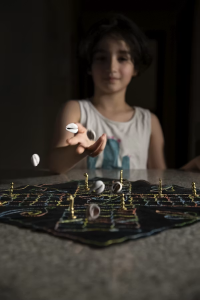
Chaupar, and its close cousin Pachisi, are the games most closely tied to the Mahabharata itself. The epic’s most consequential scene, the dice match where Yudhishthira gambles away his kingdom, his brothers, and finally his wife Draupadi at the urging of Shakuni, is generally identified by game historians as Chaupar specifically, played on a cross-shaped board with stick dice, rather than Pachisi, which uses cowry shells instead. One honest caveat worth including here: while the epic itself is ancient, game historians can only date physical evidence of the chaupar board back to around the 1500s, with Mughal-era paintings doing much of the work to cement its association with the Mahabharata in popular memory. The story and the surviving boards come from very different points in history, and it’s worth being upfront about that gap rather than presenting the connection as an unbroken, fully documented line. Pachisi’s own descendants eventually became Ludo and Parcheesi, making it one of the most widely traveled game designs to ever come out of India.
Moksha Patam, the direct ancestor of Snakes and Ladders, was built as a teaching tool for Hindu concepts of karma, dharma, and moksha rather than as entertainment first. Ladders represented virtues, snakes represented vices, and the original board deliberately included more snakes than ladders, a design choice meant to reflect that the path to spiritual liberation is harder than the path to falling short of it. Popular tradition credits the 13th-century Maharashtrian poet-saint Gyandev with the game, though some sources push its origins back much further, to around the 2nd century BCE. That earlier date isn’t settled among historians, so it’s presented here as a claim rather than a fact. By the time Jaques of London published an English version in 1892, most of the original theology had been stripped out, leaving the version most people grew up playing.
Dashavatara Ganjifa cards are less a board game than a traditional card set, but they’re worth including for how directly they carry mythology. Each suit is built around one of Vishnu’s ten avatars, from Matsya the fish to Kalki, the incarnation still to come, and a full traditional set typically runs to 120 cards. The format is generally traced to Bishnupur in Bengal, where King Bir Hambir is credited with commissioning the first set from an artist named Kartik Faujdar in the 16th century, reportedly after seeing a version of the cards at Akbar’s Mughal court.
How to Choose the Right One
Start with what you actually want out of the game. If the goal is teaching a child the sequence of the Ramayana or Mahabharata itself, Ramayana – The Epic Board Game and Discover Ramayana stay closest to the source events, moving through the story roughly as it happened. If the goal is a strategy game for older kids or adults that happens to be set in the same world, Mahabharat: War of Thrones and Ranbhoomi – Kurukshetra lean further into tactics and replayability, at some cost to strict narrative accuracy.
Player count and age range matter more than they might seem to. Trivia-format games like Discover Ramayana scale easily to larger groups, while strategy titles like War of Thrones tend to reward smaller, more focused tables. Most of the games above list a minimum age around 7 to 9, though the strategy-heavier titles play better a few years above that floor.
Finally, decide whether you actually want the epic itself or just its aesthetic. The Kurukshetra reimaginings mentioned above are genuinely fun games that happen to borrow Mahabharata characters for a new setting, which is a completely different pitch from a game trying to walk you through the actual epic.
Are These Games Accurate to the Source Texts?
It depends entirely on which game and which measure of “accurate.” The story-sequence games, Ramayana – The Epic Board Game moving kaand by kaand, or Ranbhoomi – Kurukshetra tracking the two sides of the historical battle, stay close to the events of the source texts, even if the game mechanics layered on top, dice movement, card draws, points systems, are inventions of the designers rather than anything found in the original Sanskrit.
The reimaginings are a different case entirely. Kurukshetra: Ascension resets its heroes into a fictional “Kalyug” future, and Kurukshetra: The Deck-Building War Game moves the conflict into an invented kingdom. Both use the Mahabharata as inspiration rather than as a story being retold, and neither claims otherwise in its own marketing.
Even the more faithful titles take real liberties in how they gamify events that were never designed to be games. Vardaan cards, Divyastra decks, and Punya currency are all modern design inventions layered onto ancient stories to make them playable, not features described in the original texts. None of that makes the games bad or dishonest, but it’s worth knowing which parts of any given box are epic and which parts are game design before treating anything in it as a literal retelling.
Frequently Asked Questions
What is the dice game played in the Mahabharata called?
Game historians most commonly identify it as Chaupar, the game Yudhishthira plays against Duryodhana, with Shakuni’s loaded dice, that costs him his kingdom and ultimately his family’s freedom. Pachisi, its close relative, is sometimes used interchangeably in popular retellings, but Chaupar is the more specific match to the version described in the epic.
Is Snakes and Ladders originally an Indian game?
Yes. It began in India as Moksha Patam, a game built to teach Hindu spiritual concepts, with more snakes than ladders by design, long before it was renamed and stripped of most of its original meaning by British publishers in the 19th century.
Does Kheo Games make a Ramayana or Mahabharata board game?
Not yet. Our current lineup, Panchayat, Go Goa, Samachar, and Boitas, is built around other parts of Indian culture, village life, coastal trade history, and regional art traditions rather than the two epics. If a mythology title is something you’d want to see from us, that’s genuinely useful to know, and the games above are a solid starting point in the meantime.
Are mythology-themed board games appropriate for young kids?
Most of the games above list a minimum age of 7 to 9, largely because they assume at least a passing familiarity with the story already. Younger kids generally do better with a version read or told to them first, with the game reinforcing what they already know rather than introducing the epic cold.